




ON Creative Visual Tech Provider has completed the audiovisual design and integration for Nubank Arte Lab, Brazil’s largest permanent immersive art space. The new 2,700 sq m venue is located within Conjunto Nacional, a landmark modernist mixed-use complex on Avenida Paulista in São Paulo. At the heart of Nubank Arte Lab is an extensive audiovisual platform designed and integrated by ON. It combines 29 1DLP WUXGA projectors across two immersive projection rooms, an 84 sq m transparent LED façade, an 8,352-point 3D LED sculpture and a mirrored infinity room, together with digital signage and AV systems for corporate spaces. Designed to deliver immediate visual impact, the platform can be reconfigured for exhibitions, digital art, performances and corporate events.
Opened on 15 August 2026, Nubank Arte Lab was conceived by Aventura, Brazil’s largest operator of cultural venues, and Deeplab Project, a Brazilian experience studio. The project was developed in partnership with Nubank, one of Latin America’s leading digital banks and one of the world’s largest digital financial services platforms. Its architectural design was led by Jacobsen Arquitetura, a Brazilian architecture practice. As the venue’s official audiovisual technology partner, ON was responsible for the technical AV and signal-distribution design, equipment specification and supply, installation, programming, calibration and commissioning. The company also operates the systems each day. “Nubank Arte Lab is the largest space in Brazil designed entirely to host immersive, interactive and exhibition-based projects. Our aim is to offer unique and unforgettable experiences both to our curatorial and project development partners and to our visitors,” Aventura and Deeplab Project said in a joint statement. “With ON, we found the ideal partner to bring our ideas to life. Here, technology brings sound and projection together as a shared language, inviting audiences to experience a new dimension of entertainment and the creative industries.”
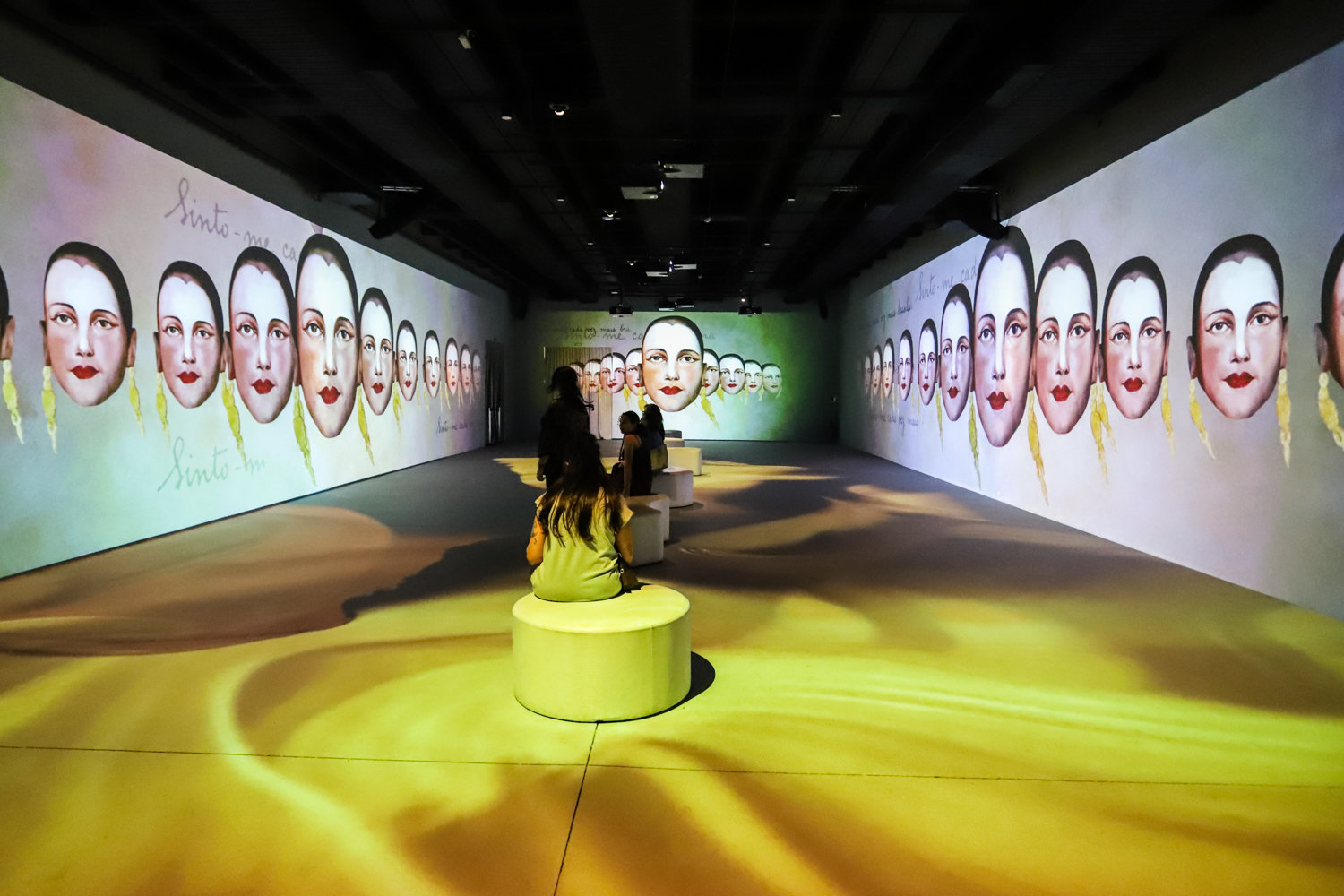
The client wanted a clear “wow factor”, but image quality and flexibility were equally important. The projection rooms had to deliver at least 150 lux, with strong contrast and consistent colour. The LED elements also needed to become part of the architecture, while the complete platform had to accommodate different content and uses. The main immersive environments are two rooms measuring 23 m by 9 m, with a four-metre ceiling and a 207 sq m footprint each. Projection covers three walls and the floor, reaching a height of 3.85 m. Mirrored surfaces complete the visual field: Room 1 has a 23 m by 4 m mirrored wall and two structural columns, while Room 2 uses a 9 m by 4 m mirror. ON deployed 29 Barco WUXGA single-chip DLP laser-phosphor projectors across the two immersive rooms. Eighteen G50-W6 units handle the wall images and 11 higher-output G62-W9 units project onto the floors. Room 1 uses 14 projectors, with eight assigned to the walls and six to the floor; Room 2 uses 15, comprising ten wall and five floor projectors. A further two projectors are kept as operational spares.
The system produces 218 lux on the walls and 174 lux on the floors, exceeding the 150-lux target. ON selected DLP technology for its black level and contrast as well as its brightness, helping dark content retain depth across large, blended images. A grey wall finish specified by ON prevents highlights from washing out and preserves contrast. Eleven custom ON producer and player servers run Dataton Watchout, managing playback, warping and edge blending. The rooms can be recalibrated and remapped as exhibitions change, allowing them to function as neutral digital canvases rather than systems built around one production. The opening exhibition, ‘O Brasil de Tarsila’, explores the work of Tarsila do Amaral, a central figure in Brazilian Modernism whose paintings helped shape the country’s modern visual identity. Across more than ten environments, around 40 works are reinterpreted through projection, interaction, an original soundtrack and sensory effects. Digital content adds depth and movement to elements from her paintings, extending imagery across walls and floors and using reflection as part of the narrative. Facing the public circulation area of the Conjunto Nacional, an 84 sq m transparent LED façade creates the venue’s first digital encounter. The L-shaped display extends 17 m across the frontage and a further four metres around the corner, and is four metres high. It uses One Display and Kinglight technology, with a variable 3.9 to 7.8 mm pixel pitch, brightness above 4,000 nits and 75% transparency. The screen has an estimated resolution of 5,376 by 512 pixels, or approximately 2.75 million pixels, and uses 168 NovaStar A5s Plus receiving cards. Its lightweight black-aluminium structure preserves views through the display. Conceived by artist Muti Randolph in dialogue with Jacobsen Arquitetura, the façade integrates moving imagery into the entrance architecture without blocking sightlines through the screen.
Elsewhere in the venue, the Voxel—a name referring to the three-dimensional equivalent of a pixel—is a volumetric LED sculpture conceived as an alternative to a conventional chandelier or architectural lighting feature. Designed as a medium for generative content, it measures approximately two metres high, four metres wide and 5.7 metres long, with 8,352 individually addressable LED points. Bespoke software developed by artist Muti Randolph allows images and movement to occupy a physical volume rather than a flat surface. Nubank Arte Lab also includes an infinity room, a mirrored immersive environment designed to create the illusion of an endless digital space. The room is built around a 10 m by 3.5 m LED wall installed by ON. Mirrors on the floor, ceiling and remaining walls repeatedly reflect the imagery, making the 35 sq m display appear to extend beyond the room’s physical boundaries. Five suspended 65-inch professional 4K displays above the ticketing area provide information through the Foyosi digital signage platform. In the corporate room, an 11 m by 4 m LED wall with a 2.9 mm pixel pitch supports plenary sessions and auditorium use. A separate space, ON Meet, is an immersive meeting room equipped with two projected walls and dedicated software for displaying large-scale imagery.
A total of 28 ON specialists worked across design, procurement, importation, installation, programming and operations. The two immersive rooms were completed 77 days after contract signature, while the transparent LED façade, Voxel, foyer displays and infinity room were delivered within 114 days, allowing the venue to open on schedule. “Delivering a project of such technical and artistic complexity within such a tight timeframe, without compromising quality or visual impact, is a major source of pride for us,” said Hugo Rodrigues, CEO of ON Creative Visual Tech Provider. “ON was involved from the initial concept, before the final contract was signed, and remains responsible for the venue’s daily technical operation. As its technology partner, we helped shape many of the technical decisions that now define the Nubank Arte Lab experience.”
ON’s involvement continued after commissioning. A technician is present every day for up to 12 hours, managing system start-up, monitoring and shutdown. The company also provides monthly preventive maintenance, corrective support and backup equipment on-site and at its São Paulo headquarters. That permanent role supports the venue’s changing programme. Five weeks after opening, Nubank Arte Lab added ‘Jornada Muti Randolph + MAOTIK’, a second experience created for the space, while ‘O Brasil de Tarsila’ remained on show. Its addition demonstrated the flexibility built into the technical design. “We helped translate the original creative and architectural vision into a reliable and flexible technical platform,” Rodrigues concluded. “Our role did not end when the doors opened: by operating and supporting the systems every day, ON is helping Nubank Arte Lab adapt to new content and continue e
