




Mike Blackman, Managing Director, Integrated Systems Europe, commented: “DSS has grown again this year, and the energy across the event has been fantastic. We’ve seen outstanding discussions, strong international attendance, and particularly good to see a contingency from the Middle East. There’s been a very positive response from both sponsors and visitors. While the market continues to face challenges, the mood here has been remarkably optimistic. There’s genuine enthusiasm for where the industry is heading.”
Day 1 Keynote Takeaways
Florian Rotberg, Managing Director, Invidis & Stefan Schieker, Senior Partner, Invidis
The opening keynote at the 20th edition of the Digital Signage Summit Europe in Munich painted a picture of an industry navigating uncertainty, consolidation and rapid technological transformation, but also one entering a period of significant long-term opportunity. Despite geopolitical instability, supply chain disruption and major vendor shakeups, the overall message was clear and optimistic: digital signage remains resilient, adaptive and strategically important. From AI and cybersecurity to enterprise IT integration and orchestration platforms, DSS highlighted how the market is rapidly evolving beyond standalone displays and into wider operational technology ecosystems.
“We chose Next Generation Signage as a theme because there is so much disruptive tech, and AI is just one of them,” said Florian Rotberg, Managing Director at Invidis. “The role of AI is changing and the idea of being a master of your silo is not so relevant anymore. It’s about orchestration. Digital Signage is here to stay, it’s just changing – and the players are changing too.”
A Market Under Pressure. But Still Growing
According to Invidis, 2025 was largely flat for the industry overall, particularly on the hardware side, while software and services continued to grow at a slightly faster pace. Moving further into 2026, the market faces a highly volatile operating environment. Supply chain instability, cybersecurity threats and shifting global logistics realities are all having a direct impact on the digital signage ecosystem. One of the keynote’s strongest themes was the growing importance of cybersecurity. With increasing attacks on data centres and critical infrastructure, signage networks are now being viewed through a far more security-conscious lens. Risk mitigation, secure remote management and software-defined infrastructure are becoming critical priorities for customers and vendors alike.
At the same time, the industry is experiencing major structural change:
•Stratacache was described as “fading out”
•Scala was described as approaching end-of-life (before the news broke with Vertiseit)
•Vestel has exited the digital signage market amid intense Chinese competition
•Google, Adobe and Cisco have all strategically withdrawn from parts of the signage market
Florian referred to some of these moves as “enterprise fails”, though he also noted that large enterprise players often re-enter the market in new forms over time.
LED Continues to Dominate
A major growth driver remains LED technology, which Invidis predicts will dominate the market through 2026-2029 and beyond.
LED is expected to overtake LCD in terms of market value, reflecting continued demand for immersive, large-format and experience-led display environments.
At the same time, the industry is seeing:
•stronger migration toward software and managed services
•increased demand for lifecycle management platforms
•more remote asset management and orchestration tools
•growth in consulting-led engagements where ROI and measurable outcomes matter more than ever
The keynote repeatedly returned to one central idea: customers increasingly want measurable business results, not just technology deployments.
AI: Disruption, Opportunity and Risk
AI was naturally a major focus throughout the presentation. One notable point was the suggestion that AI is beginning to cannibalise traditional SaaS business models, described by some as the “AIpocalypse.”
However, the speakers argued that digital signage may prove more resilient than other technology sectors because it remains fundamentally a screen-based, physical-world industry. AI is disruptive, but potentially less destructive here than in purely software-based markets.
An interesting mention was “Lovable,” an AI-driven development tool that enables rapid creation of front-end demos and product concepts. While developers are excited about its speed and flexibility, the speakers warned of significant associated security risks.
Another trend discussed was the enormous AI-driven investment boom currently reshaping infrastructure and cloud computing economics, including:
•rising memory costs
•supply chain pressure
•hyperscaler spending, including Google’s reported $170 billion AI investment push
Consolidation, Convergence and New Growth Areas
Invidis highlighted several long-term growth sectors that are reshaping the industry landscape:
•Enterprise communications
•Workplace experience platforms
•Retail media
•Managed signage services
•Defence and cybersecurity
•Airports and transportation
•AV/IT/digital signage convergence
Retail media was repeatedly described as a continuing boom area “here to stay.”
Meanwhile, defence emerged as one of the keynote’s more unexpected growth stories. The speakers pointed to increasing investment in secure communications, remote access control, software-defined infrastructure and community resilience systems – with startups entering the sector rapidly. They stressed that this is not a short-term opportunity but a potentially massive long-term growth category.
Geographically, Africa was highlighted as “the new Middle East” in terms of large-scale infrastructure and display projects, especially in airports, with significant market potential emerging across the region.
The speakers also noted that the industry is entering a new phase of mergers and acquisitions, suggesting the current wave of consolidation is “only the beginning.”
“Signage and Meeting Rooms Are Dead…”
One of the standout comments from the day came during a discussion with Jon Sidwick of bluetouchpaper.
“Signage and meeting rooms are dead… as we know them,” Jon stated.
The discussion centred around the emergence of a “K-shaped market,” where investment is increasingly concentrating into high-value, experience-led environments rather than commoditised deployments.
The implication was clear: the future of the industry will depend less on simply deploying screens and more on redefining how digital experiences function within physical spaces.
Rethinking the Role of the Screen
Perhaps the keynote’s biggest strategic message was that next-generation signage now needs a genuine rethink to:
•digital canvases
•content distribution
•digital interactivity
•ecosystem roles
•evolving service models
Examples already emerging include companies like Econocom and Samsung offering white-label managed service provider (MSP) models.
Workshop Notes: The Enterprise Tech Stack – Where AV Meets IT
Jason Cremins, Navori Labs, Jon Sidwick, bluetouchpaper
This session explored the continued convergence of AV, IT and enterprise communications infrastructure, with discussion focused on how workplace technology is increasingly being driven by enterprise IT requirements rather than standalone AV considerations.
A major topic was MDEP (Microsoft Device Ecosystem Platform) and its growing role in enterprise collaboration and signage environments. Speakers highlighted several key advantages of the platform, including:
•Enterprise-grade security
•Simplified certification pathways
•Improved manageability for IT teams
•Easier device deployment and maintenance
•Broader ecosystem growth and interoperability
The discussion also touched on the influence of AI and emerging enterprise platforms, with references to technologies and companies such as Anthropic and Mythos, reflecting the broader industry focus on intelligent collaboration tools, automation and AI-driven workplace experiences.
DSS Europe 2026 – Day Two
Women’s Breakfast & Workshop
This year’s women’s breakfast was sponsored by Lang AG and hosted by Antonia Hanberger. Kamilla Lang presented “A Ticket to Hell? AI and the Future of Gendered Occupational Segregation” focusing on AI’s impact on workforce diversity and inclusion.
In the adjoining workshop, speakers Tamara Bebb, spectrio, Mónica Fernandez Bové, nsign and Kamilla Lang, Lang AG, discussed the topic “Levelling the Playing Field: Mastering AI, Negotiation and Networking”. Themes included negotiation skills, networking strategies, AI literacy and workplace empowerment and creating more equitable opportunities in tech and AV industries.
Opening Keynote
Delivered by Florian Rotberg and Stefan Schieker.
Naturally, the morning opened with topic everyone was talking about when the news broke the previous evening – that Scala has been acquired by Vertiseit. Vertiseit’s CEO Johan Lind said that the acquisition positions Vertiseit as the second-largest European pure-play digital signage software company globally.
DSS 20-Year Retrospective
Digital Signage Summit is celebrating its 20th anniversary this year.
Reflections included:
•Early confusion around the term “digital signage,” was mistaken for “digital signature.”
•Evolution of the market from niche technology to mainstream communications infrastructure.
•Challenges faced during the COVID era and the summit’s shift to online formats.
•Archive photographs and memories from the event’s early years highlighted the industry’s transformation.
“The Hard Truth – The 20-Year Learning Curve”
In this workshop featuring: Dave Haynes, Florian Rotberg and Stefan Schieker, themes discussed included:
•Lessons learned over two decades of digital signage evolution.
•Industry growing pains and unrealistic expectations over the years.
•The shift from hardware-centric conversations to software, data and operational outcomes.
•Importance of resilience and adaptability through economic and technological change.
DSS 2026 Wrap Up
Rotberg described DSS as “a safe space for networking”, adding that the event enables “extended quality conversations” and provides “a hub for trust amongst peers, with the opportunity to forge new connections and partnerships.”
That emphasis on collaboration felt particularly relevant at a time when the industry is navigating consolidation, vendor exits and rapidly changing business models.
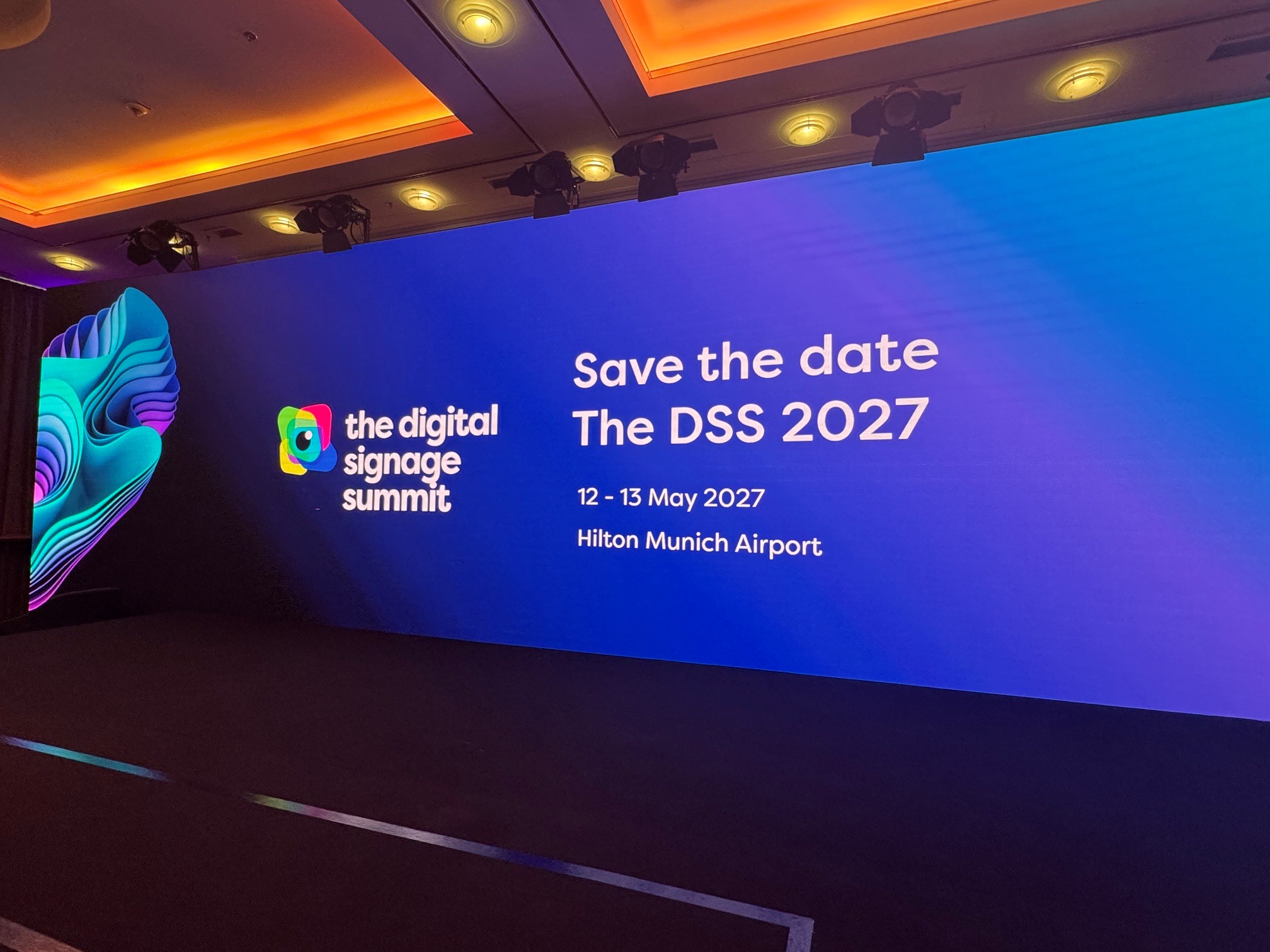
Rotberg concluded, “Invidis is proud to be at the centre of it all. We are connecting people and bringing them together. Breaking the news, creating a platform to share industry insights, analysing trends and making predictions. The energy this team puts into the event year on year is fuelled by our passion for the DS industry. We have so many ideas, always looking for ways to try something different. We’re pleased to hear people liked the set up this year – our 20th no less – and we look forward to bringing it back next year. Which brings me onto the 2027 dates – save the date: 12-13 May 2027 at the Hilton Munich Airport.”
Showfloor Spotlight: Pantheon Lab
One standout company on the exhibition floor was Pantheon Lab, partnering with Samsung and other hardware providers to develop hyper-realistic AI-powered digital humans designed for two-way customer interaction.
Unlike traditional chatbots, the company positions its avatars as “physical agents” capable of acting as trained representatives of a brand or organisation.
Applications include transportation and wayfinding, customer service, training, retail experiences and enterprise communications.
The company referenced work with HSBC in Hong Kong, where digital humans are being used to transform physical branch experiences by guiding visitors through services and interactions.
Pantheon Lab emphasised strong security architecture, ISO certification, secure handling of user data, emotionally intelligent interactions, augmentation of staff productivity rather than staff replacement.
Showfloor Spotlight: Ameria
Another notable exhibitor was Ameria, a provider of gesture control technology for software developers. The company was showcasing AI-powered, glasses-free 3D experiences powered by gesture recognition. Its technology allows users to interact with displays by hovering hands or fingers over the screen without physical contact. Applications include healthcare and surgical environments, construction, public interaction spaces, retail engagement and immersive experiences. Ameria is collaborating closely with Samsung on this and also with Sony for its touch-free product called STARKIT by America – currently available in 27”. Launch took place at ISE 2026 together with the Sony 3D Spatial Reality Display on the booth. Target markets are events/tradeshows, experience centres, flagship stores and museums. Ideal for creating a wow experience for brands. Could be used in medical for MRIs, in automotive or architectural for CAD designs.
Showfloor Spotlight:
Concept International GmbH Meeting
Concept International GmbH is a distributor and manufacturer with a network of approximately 600 integrators. Based in Munich, the company offers one of the widest portfolios of media players in the market and products are deployed across multiple verticals including retail, gas stations, airports and education.
FutureLED “Butterfly” is Concept’s own LED brand and was showcasing at DSS. This is an energy-saving LED product with high-to-low brightness capabilities, showing as a two-sided, slim 28mm thick display designed for window placement.
Its C-Paper is a coloured e-paper door signage solution, requiring only minimal power to update content, otherwise consumes zero power when static thus positioned as an energy-efficient signage option.
Its POS 3D Displays are available in 16-inch, 27-inch and 55-inch formats. Applications include airports and wider commercial environments.
Its PC Modules are widely integrated into interactive whiteboards in education environments.
Meet:Ink is a new proprietary room-signage solution. Wi-Fi based e-paper signage with no additional powered access points required.
Showfloor Spotlight: Sharp and tisensi
Sharp is partnering with Polish company called tisensi, a new sustainable digital signage brand that recently secured a €250,000 EU investment grant. Founded in 2023, the company launched its first e-paper products in 2024 and has since begun cooperating with Sharp.
Tisensi’s proposition centres around sustainability and flexible deployment. The products incorporate recycled plastics and low-power materials, while also featuring an integrated mounting system and enclosure design. The displays include an EMS system with internal batteries, enabling versatile installation and mobility.
Use cases demonstrated included hanging installations, shelf placement and podium integration. The platform enables quick content changes remotely, allowing centrally managed updates across installations.
Tisensi works with both integrators and end users, and can adapt products to meet custom branding requirements while maintaining sustainability goals.
Sharp were also showcasing various LED pixel card configurations and display formats.
Showfloor Spotlight: Radix
Based in Israel, Radix positions itself as the orchestration and device management layer sitting between hardware manufacturers and CMS platforms. The company is not a CMS provider or a device manufacturer; instead, it acts as the “glue” that enables different technologies and endpoint devices to work together efficiently and at scale.
Their platform focuses on the management and orchestration of all types of endpoint devices, providing visibility into device updates, running assets and applications, performance and operational insights and systems operating both inside and outside environments.
One of the company’s core messages is: “We manage everything,” reflecting its emphasis on unified orchestration across complex deployments.
While the company has officially focused on the digital signage market over the last few years, it also serves sectors including education and hospitality, where large-scale device management and interoperability are increasingly important.
The company’s positioning strongly reflects a growing industry need for scalable orchestration, remote management and interoperability as signage ecosystems become more complex and distributed.
Showfloor Spotlight: SignageOS
Prague-based SignageOS returned to DSS Munich for its fifth year, showcasing Devspace, its device management platform designed to simplify deployment across fragmented digital signage ecosystems. Operating globally, with much of its business concentrated in the US market, the company positions itself as a universal device management and orchestration layer for the digital signage industry.
Rather than requiring software developers to build native integrations for individual hardware platforms, Devspace enables companies to deploy solutions across multiple device types through a single standardised environment.
The company’s typical customers are software providers developing their own signage platforms and applications, with SignageOS aiming to reduce complexity, improve interoperability and streamline large-scale deployment.
