




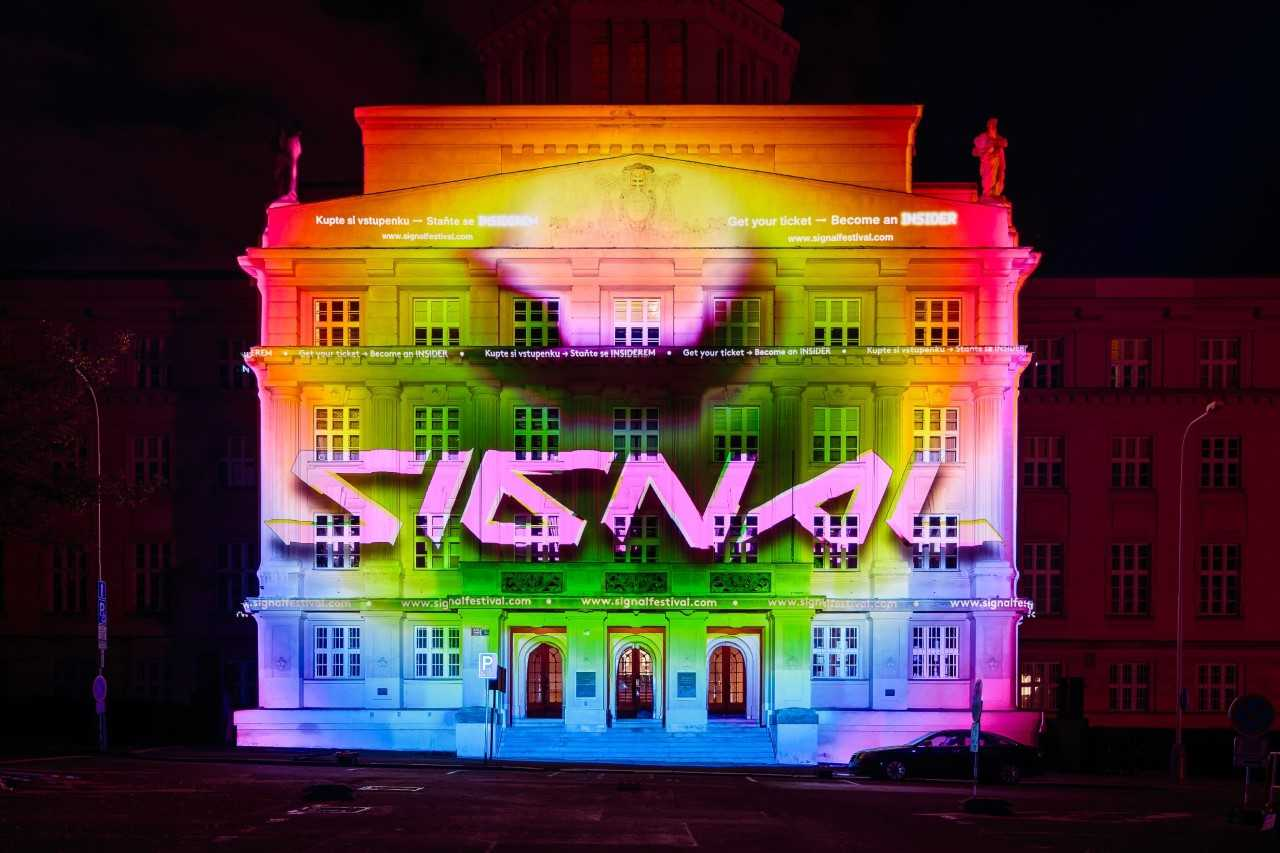
Panasonic returns to Signal Festival as its projection technology partner for the second consecutive year, supporting artists and technical teams in bringing digital artworks to life across Prague. Taking place from 15 to 18 October, the festival’s 14th edition features 21 installations that connect contemporary art, digital technology and architecture. Alongside projectors from its established portfolio, Panasonic is introducing its new PT-RQ45 4K projectors and Beeblade Pluto media players from HIVE Media Control at this year’s festival. The PT-RQ45’s 42,000-lumen brightness supports projection onto large façades, while HIVE’s technology provides synchronised video playback across multiple projectors.
Signal Festival’s varied locations and artistic concepts present challenges familiar to event producers and AV professionals: projecting onto large façades, adapting content to architectural features and coordinating playback across multiple devices. Through its continuing partnership with the festival, Panasonic helps artists and technical teams select and use the technology needed to bring their creative ideas to life. Julius Štefan of Signal Festival says: “We chose the PT-RQ45 projectors for their high brightness and image detail, which are essential when projecting onto a large façade, while HIVE’s Beeblade Pluto media players provide synchronised content playback and control. HIVE has been a great fit for the event – the system is easy to use, eliminates need for rack space and simplifies setup. Both technologies are new to our festival, but our experience of working with Panasonic gave us the confidence to use them in front of a live audience. We want artists to have access to the latest technologies, and Signal Festival is the place to put those possibilities into practice.”
At Signal Festival, Panasonic’s PT-RQ45 projectors will bring German artist Felix Frank’s ‘Missing Interval’ to the façade of the Archbishop’s Seminary in Prague’s Dejvice district. A new projection mapping location for 2026, the historic building will also host the festival’s official opening ceremony on 15 October. The PT-RQ45 is a 3-Chip DLP laser projector designed for large venues, live events and projection mapping. Its 42,000-lumen light output provides the brightness needed for large-scale images, while its 3840 × 2400-pixel resolution, achieved using Panasonic’s Quad Pixel Drive technology, reproduces fine detail in the artwork. Despite its increased light output, the PT-RQ45 retains almost the same body dimensions as Panasonic’s PT-RQ35 series, a practical consideration for teams transporting, positioning and installing the projectors.
HIVE Media Control develops compact, scalable media players and software for projection mapping, immersive experiences and permanent installations. Its technology enables synchronised content playback and control across multiple projectors and displays. Unlike conventional media servers that occupy a 19-inch rack and a dedicated server space, the HIVE players can be slotted into the projector, bringing the playback function directly into the display device. This revolutionary concept is a game changer for temporary and fixed installations in terms of equipment load and cost.
At Signal Festival, seven Beeblade Pluto media players are being used across three installations, delivering high-resolution video content to Panasonic projectors. HIVE’s Beesync software keeps playback synchronised, allowing multiple projected images to work together seamlessly. From illuminating Prague’s historic architecture to supporting synchronised media playback across multiple installations, Panasonic’s involvement at Signal Festival reflects a broader evolution in its approach to visual technology. By bringing HIVE Media Control’s playback and control capabilities alongside its established projection portfolio, Panasonic is expanding beyond individual products to support the wider technical ecosystems that make ambitious visual experiences possible. Ultimately, it is about giving artists and technical teams the tools and flexibility to bring their creative visions to life, allowing technology to work behind the scenes while the art takes centre stage.
